Every industrial technology company has one. The customer sales mentions in every second meeting. The system has been live for months. The logo sits on the website. The operations lead is happy and has said so, once, in a corridor, to someone who has since changed roles.
There is no film.
A contact at a technology vendor once told me, about one of their biggest customers, that the film was long overdue. The system was running. The relationship was good. Nobody questioned the value. It still hadn't happened.
That sentence stayed with me.
Everyone agreed, and nothing moved.
A live customer is proof with a shelf life
A live reference has something no sales deck can offer. Someone with a budget and a reputation at stake already took the risk.
That is what the next buyer is looking for. They rarely doubt that the technology works. They doubt that it will work in a building like theirs, with their products, their shift patterns and their IT department. A logo tells them a customer exists. An operations leader explaining what changed, and what was harder than expected, answers the actual question.
This proof fades. Champions move on. The go-live story loses its energy. The team that lived through the project forgets the difficult weeks, and the difficult weeks are the part that persuades. A reference you could have filmed last year may be a weaker film today, and in two years it may be no film at all.

Why the film never happens
Nobody decides against it. It dies in three quiet ways.
The ask, as it feels
The ask, as it runs
The approval feels too heavy. A customer film needs a yes from communications, usually legal, often site security, sometimes a parent company. Vendors assume this is a big ask, so they don't make it. That protects the relationship and costs the reference.
The calendar is never right. The site can't host anyone before peak season. After peak comes the next rollout. “After Q4” quietly becomes next year.
Nobody owns the ask. Sales wants the film. Marketing holds the budget. Customer success holds the relationship. Each assumes one of the others will raise it. Meanwhile the trade fair and the product launch have hard deadlines, and a reference film has none, so it loses every time.
All three look like external obstacles. Only the first one involves the customer, and in most cases nobody has actually tested it.
Make the ask small
Customers say no to vague requests. “We'd love to do a video with you” sounds like weeks of disruption. A specific request sounds like a morning.
Put it on one page. Who comes, on which day, for how long, who speaks, what appears in frame and what stays out. That page is what legal and site security need to see, and it lets your contact forward the request instead of explaining it.
Customer film: the request on one page
- Who comes
- Director, camera, sound
- Day
- One weekday, set around your shifts
- Duration
- One day on site
- Who speaks
- Site manager, operations lead
- In frame
- The system running, the team at work
- Out of frame
- Restricted areas, workpieces under IP, third-party names
- Sign-off
- One named approver, agreed rounds
Your contact forwards this. Nobody has to explain it.
Plan around the site. Shift schedules, safety briefings and restricted areas are the starting point of the shoot plan. A crew that adapts to the building is easy to invite back.
Ask for little executive time, and use it well. Senior people give you a fixed slot. We have filmed a CEO together with senior leaders of a major customer, and it worked because questions, framing and sequence were settled before anyone sat down. Preparation replaces shooting time, and a short briefing call beforehand does more than a second take.
Settle approval before the shoot. Agree who signs off, how many rounds there are, and what is off limits, such as throughput figures or floor layouts. Once those lines exist, nobody on the customer side has a reason to worry about what comes out of the edit.
Give the customer something too. The film shows their operation as modern and well run. That is useful for recruiting, for internal communications and for their own leadership. Offer them a cut of their own. The request then stops being a favour.
You don't just start shooting
In an industrial setting, nobody turns up and starts rolling. Least of all when a customer relationship is part of the picture.
We have seen approvals come through surprisingly fast the moment one thing was clear: certain parts of production would not be filmed. So we raise it ourselves, before the customer has to. Which areas of the hall can't be entered with a camera? What must not be shown at all? Those two questions tell the site that its boundaries come first.
The same goes for the paperwork. We offer upfront to complete safety inductions and sign NDAs, before anyone asks. That offer alone signals that professionals are coming.
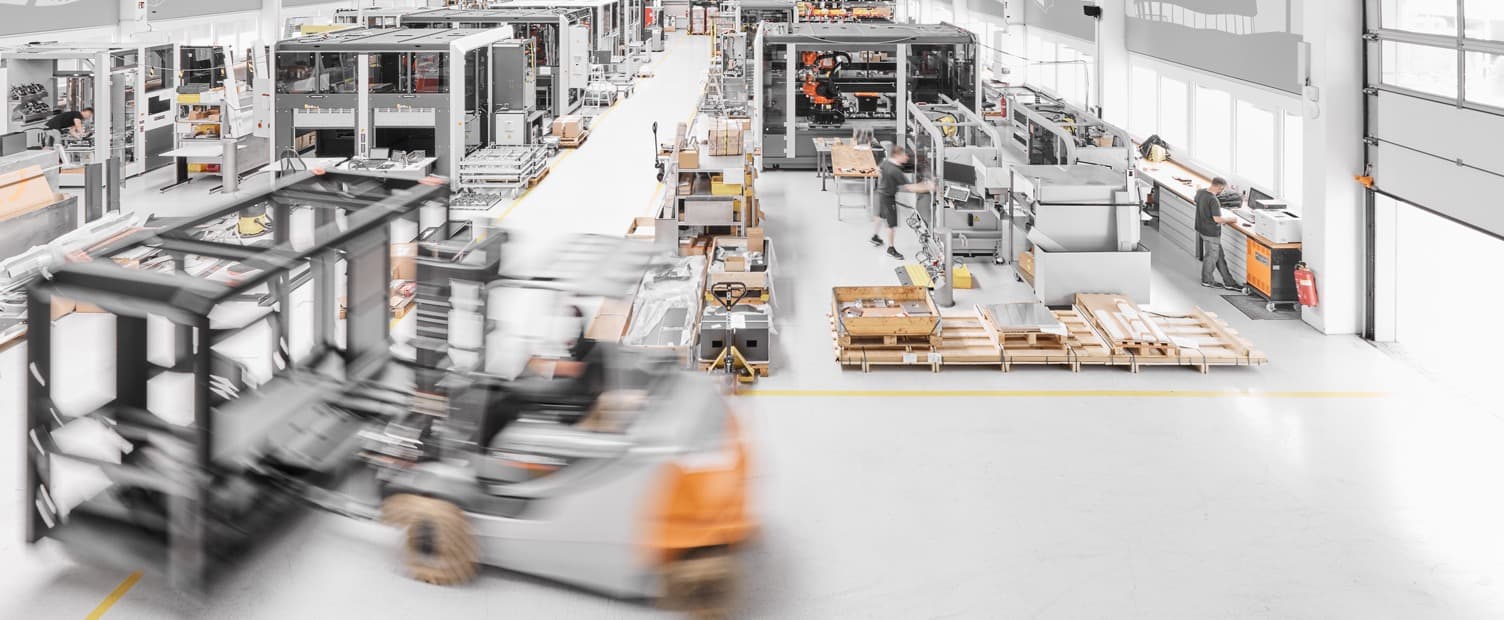
Then there is everything that ends up in frame: logos, goods, workpieces, and the names of the customer's own customers. A workpiece may be covered by IP. A label may reveal a business relationship. We clarify in advance what can be shown, what has to stay out of shot and what has to be made unrecognisable, and we build that into the plan. On the day, we ask again whenever the crew reaches a sensitive area.
- 1Goods on pallets. Whose name is on the label?
- 2Machine cell. Is the workpiece covered by IP?
- 3People in frame. Have they agreed?
- 4Screens and paperwork. Is anything readable?
It comes down to direct, thorough communication, finished before a camera or a crew arrives at the site.
What the film does when you're not in the room
Most of a B2B buying decision takes shape before anyone calls you. In automation, that decision also passes through people your sales team will never meet.
The operations lead likes your system and has to convince finance, IT and safety. Your datasheet answers their questions about specifications. It does little for the worry behind the decision: what happens to me if this goes wrong? A peer who already went through it answers that worry directly, and a link to a film is easy to forward internally.
One shooting day can serve all of them. The longer version belongs on your website. Shorter cuts built around one answer each give sales something to send after a first meeting: integration for IT, the business case for finance, day-to-day operation for the floor. The same material runs as paid media against the accounts you're already working.
Few sales assets keep working after the meeting has ended. This one does.
Start with one customer
You don't need a content programme. You need one day.
Use that day to create as many formats as possible. A specialised production team such as the crews at Cat. will gladly produce not just one film. It is vital in this day and era to think in both short and long-form pieces. Bite-size chunks and “the long view” for the intrigued lead.
List your live customers and mark the ones with no film. From that list, pick one where the relationship is good, the system is stable and your champion is still in the role. Name a single owner on your side. Then put the request on the agenda of your next regular customer meeting, with the one-page outline in hand.
If they say yes, you have a reference. If they say no, you have learned something about that relationship that you wanted to know anyway.
The hardest part of a reference is a customer who trusted you with their operation. You already have that. Everything after it is a shooting day.
Have a reference worth filming?
We plan the shoot around your customer's site, boundaries and approvals.